
TNPSC Books
-
 TNPSC General English Book - for Group 2 & 2A
Original price was: ₹1,000.00.₹850.00Current price is: ₹850.00.
TNPSC General English Book - for Group 2 & 2A
Original price was: ₹1,000.00.₹850.00Current price is: ₹850.00.
-
 TNPSC பொதுத் தமிழ் Book - for Group 2, 2A, 3, 4 & VAO
Original price was: ₹1,000.00.₹850.00Current price is: ₹850.00.
TNPSC பொதுத் தமிழ் Book - for Group 2, 2A, 3, 4 & VAO
Original price was: ₹1,000.00.₹850.00Current price is: ₹850.00.
Group 1 Courses

TNPSC Group 1 - Test Series - 2019
Original price was: ₹3,500.00.₹2,800.00Current price is: ₹2,800.00. 542
Class Tests
PRIVATE 67
Group 1 | Postal and Online Test Series | 2022
Original price was: ₹3,200.00.₹2,800.00Current price is: ₹2,800.00. 88


Group 2 & 2A Courses
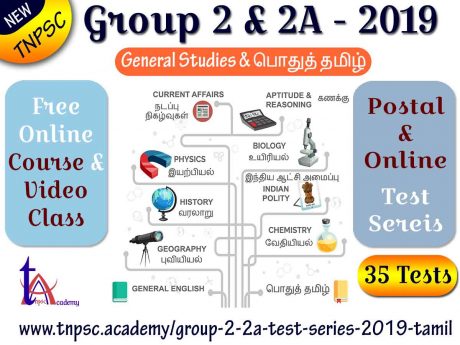
TNPSC Group 2 and 2A - Test Series - 2019 - தமிழ்
Original price was: ₹2,400.00.₹1,800.00Current price is: ₹1,800.00. 175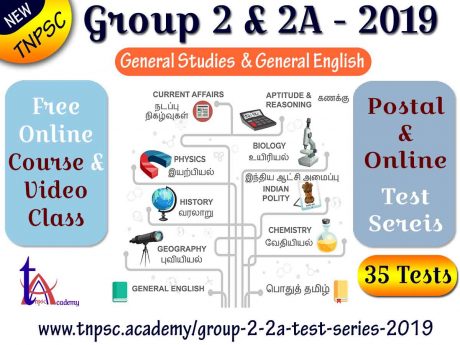
TNPSC Group 2 and 2A - Test Series - 2019
Original price was: ₹2,400.00.₹1,800.00Current price is: ₹1,800.00. 527
TNPSC Group 2 and 2A MAINS - 2022
PRIVATE 344Class Tests
PRIVATE 67


www.tnpsc.academy – Important TNPSC Current Affairs April (21-30) 2021
Topic: International Events
Russia to launch its own Space Station
The agreement between Roscosmos and its international partners is to run out in 2024. With this, Russia has planned to pull out of the International Space Station and launch its own space station in 2025.
According to Russia, the structure of the International Space Station is ageing. With the station becoming older, it can lead to irreversible consequences.
International Space Station:
The International Space Station was launched by the US space agencies and Russian Space agencies in 1998. The other countries that were involved in the launch of the International Space Station were Canada, European Space Agency and Japan. The ISS revolves around the earth in 93 minutes. It makes 15.5 orbits per day. It travels at an orbital velocity of 7.7 kilometres per second.
After Russia’s withdrawal, the future of ISS is to be made based on the conditions of technical modules in the station. Most of the technical modules in the station have reached the end of their service life.
Russian Space Station:
The Roscosmos also announced that the first core module of the new Russian orbital station is ready. Russia aims to launch the module by 2025. This new space model is being assembled at a cost of 5 billion USD.
_
Topic: Person in News
GC Murmu chosen as external auditor by OPCW
G C Murmu has been chosen as the External Auditor of Organisation for Prohibition of Chemical Weapons (OPCW).
Key facts:
G C Mumru is currently serving as the CAG of India. He has been appointed as the External Auditor of Organization for Prohibition of Chemical Weapons. He will serve at the OPCW as an External Auditor for three years. Also, India was elected as the member state of the Executive Council of OPCW in the Asia region for another two years.
_
Topic: New inventions on Science and Technology
DRDO Single Crystal Blade Technology
The Defence Research and Development Organisation recently developed the Single Crystal Blade Technology. The organisation has delivered sixty of such blades to the Hindustan Aeronautics Limited. A very few countries in the world possess this technology. They are UK, USA, Russia and France.
What is Single Crystal Blade?
The helicopters need powerful and compact aero engines to operate in extreme conditions. In order to achieve this, Single Crystal Blades are essential. The Single Crystal blades are made of nickel based super alloys. These alloys are capable of withstanding low temperatures. The technology is to be used in helicopters.
What is Single Crystal Blade Technology?
Normally the “Grain Boundary” technology is used in making blades. Here the metal forms grains while solidifying.
Usually, metal alloys are used in making blades. Different metals in the alloy produce different grains while solidifying thereby creating grain boundaries. Basically, a grain boundary is an interface between two grains or crystals. These boundaries lead to creep in the blades.
The problem of creep is overcome in Single Crystal Blade technology by designing alloys that can be used in single crystal form. This means that no boundaries will be formed here. The technology uses a vacuum investment casting process to realise the blades. This includes ceramic moulding, wax patterning, heat treatment.
It is essential to formulate special ceramic composition for the technology. This involves making strong ceramic moulds that withstands metallostatic pressure at 1500 degrees Celsius.
Topic: International Events
Varuna 2021: India-France Naval Exercise
The Indian and French Navies recently conducted the Varuna Naval Exercise in the Arabian Sea. The Varuna, 2021 is a part of the Clemenceau 2021.
About Varuna 2021:
The exercise included surface and anti-weapon firings, tactical manoeuvres, rotary wing flying operations including cross deck helicopter landings and air defence and anti-submarine exercises.
The Indian Navy was represented by Stealth destroyer INS Kolkata, INS Talwar, INS Tarkash, Fleet Support Ship INS Deepak, Chetak Integral helicopters and a Kalvari class submarine. Also, the P81 Long range Patrol Aircraft participated. The French Navy was represented by E2C Hawkeye aircrafts, Rafale-M fighter, Horizon class air defence destroyer Chevalier Paul.
_
Topic: International Events
UK to allow Driverless cars on roads
The United Kingdom has become the first country to announce regulation for the use of self-driving vehicles at low speeds.
Key facts:
The UK wants to be at the forefront in rolling out autonomous driving technology. The Government of UK forecasts that around 40% of UK cars will have self-driving capabilities by 2035. This will create 38,000 jobs in the country.
_
Topic: New inventions on Science and Technology
India’s first 3D printed house at IIT-M
The Union Finance Minister Smt Nirmala Sitaraman inaugurated the first 3D printed house at IIT Madras.
About the House:
The House was constructed using indigenous 3D printing technology. It was built in just five days. It was built by TVASTA Manufacturing solutions based on a concept by former IIT-M students.
What is 3D printing?
3D printing is a process of making three dimensional objects through digital instructions. It is also called Additive manufacturing.
It is the opposite of Subtractive Manufacturing. Subtractive Manufacturing is cutting away from a large material.
The Global market of 3D printing is expected to reach 34.8 billion USD by 2024.
3D Printing in Construction:
In the construction sector, it takes a lot of hard work to create a detailed, handmade and scaled product.
With 3D printing the task becomes easier especially when complex geometries are involved. It can render detailed models in terms of colour and range of materials.
_
Topic: Awards and Honours
Japan’s Order of the Rising Sun honour to Bengaluru Teacher
The Japanese Government recently awarded the “Order of Rising Sun” to a Bengaluru based Japanese teacher, Shyamala Ganesh.
About Shyamala Ganesh:
Shyamala is a Japanese teacher at the Septuagenarian institution and also at the Ohara School of Ikebana in RT Nagar, Bengaluru. She has tutored more than hundreds of students since its inception 38 years ago. Ikebana is Japanese art of flower arrangement. Shyamala along with her husband Ganesh started a Japanese language school in 1983 in Bengaluru.
Order of Rising Sun:
The award is presented by the Emperor of Japan. It was created in 1875. The award is presented to those who have made distinguished achievements in promotion of Japanese culture, achievements in international relations, advancements in their field and conservation of environment.
It is the third highest award presented by the Japanese Government. The culture of presenting the award to Non-Japanese recipients began in 1981. Women are presented with the award since 2003.
_
Topic: International Events
World Press Freedom Index 2021
India has ranked 142nd yet again out of 180 nations in the recently unveiled World Press Freedom Index. The index is published each year by the international journalism not-for-profit body, Reporters Without Borders (RSF).
About the World Press Freedom Index:
It has been published every year since 2002 by Reporters Sans Frontieres (RSF) or Reporters Without Borders. The Index ranks countries and regions according to the level of freedom available to journalists. However it is not an indicator on the quality of journalism.
The parameters include pluralism, media independence, media environment and self-censorship, legislative framework, transparency, and the quality of the infrastructure that supports the production of news and information.
Global Scenario:
Norway has topped yet again for the fifth year in the row, followed by Finland and Denmark.
Eritrea is at the bottom meanwhile China is ranked 177, and is only above North Korea at 179 and Turkmenistan at 178.
India’s Performance Analysis:
India was ranked 142 in the year 2020 as well, thus showing no improvement in the environment it provides to its journalists. India has fared poorly amongst its neighbours with Nepal at 106, Sri Lanka at 127 and Bhutan at 65. Pakistan is a close follower at 145th spot.
_
Topic: International Events
World’s Oldest Water
World’s Oldest Water Found in Canada Sheds Light on the Beginning of Life.
In 2019, geologist and earth sciences professor Dr. Barbara Sherwood Lollar of the University of Toronto received the top science prize of the Gerhard Herzberg Canada Gold Medal for Science and Engineering worth $1 million for discovering the world’s oldest water.
It was found at a depth of 2.4 kilometers in Kidd Creek Mine. The water is highly saline, which is ten times saltier than seawater.